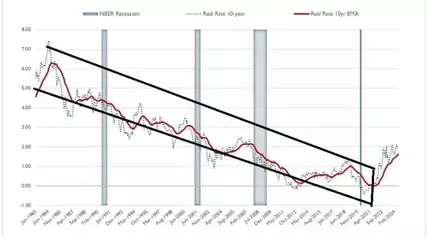
The Music Stopped Playing in 2012
Rethinking Downtown: Addressing the Complexities of Commercial Rent and Property Values
The article delves into the challenges facing downtown Santa Barbara, where high rents have made it difficult for local shops and restaurants to thrive. The author argues that the root cause of this issue lies in the misunderstanding of financial theory among homeowners, business owners, and commercial landlords, who have become accustomed to the steady rise in property values driven by falling real interest rates over the past four decades.Unlocking the Potential of Downtown Santa Barbara
The Disconnect Between Rent Expectations and Market Realities
The author emphasizes that the music stopped playing in 2012 when real interest rates bottomed out in negative territory, yet homeowners, business owners, commercial landlords, and city councils continue to dance to the same tune. They fail to recognize that stocks and real estate are forward-looking assets, priced according to global investors' willingness to hold them, based on their estimates of discounted future cash flows. The current socioeconomic environment and market psychology dictate how far into the future investors are peering at any given time.The author refutes the common misconception that stocks and real estate prices will always rise cyclically, as well as the notion that Santa Barbara property values will always increase due to its desirability as a place to live. While Santa Barbara housing prices will likely remain relatively high, they are not disconnected from global markets and will generally track the rise and fall of global risk asset markets, albeit starting from a higher level.The Role of Commercial Landlords and Financial Literacy
The author argues that even if the City Council implements an award-winning plan for downtown revitalization, it won't solve the core issue: commercial landlords who do not understand basic financial theory or have painted themselves into a corner by borrowing too heavily based on rental yield projections that stopped being realistic in 2012. As a result, these landlords refuse to lower rents, further exacerbating the challenges faced by local businesses.The author's experience suggests that commercial landlords and homeowners either don't understand or refuse to face the fact that property values are based on unrealistic rent expectations, given the nearly 40-year trend of falling real interest rates. This lack of financial literacy among property owners is a significant barrier to addressing the challenges facing downtown Santa Barbara.The Limitations of Political Ideology and Economic Theory
The author acknowledges that the mayor and City Council may or may not be aware of the finer points of financial theory, but like all local politicians in the United States, they are at the mercy of a dysfunctional capital allocation system that has not evolved since the nation was a sparsely populated agrarian society.The author argues that economics is not a natural science, but rather a political philosophy without natural laws. Economists often fail to understand that the most relevant demand in real estate is the demand for rental yield, not shelter. This misunderstanding allows special interest groups to use economic theory to mold public opinion, leading the public to believe that economics is a functional science with proven claims.Rethinking the Role of Real Estate in Economic Development
The author contends that anchoring economic activity on real estate is a mistake, amplified by the diffusion of agglomeration effects from physical communities to digital networks, where the physical location of firms and people is no longer a critical factor in creating these effects. Real estate is overvalued in large parts of the developed world and is headed for a series of deflationary cycles, which could be exacerbated by significant private market property write-downs and lower rents.The author suggests that the solution to dysfunctional downtowns, like the housing, health care, and education crises, lies in government funding for necessary goods and services. However, the pervasive political propaganda in America makes it challenging to implement such solutions, as they are often labeled as "socialist" ideas.The author expects towns and cities across the U.S. to endure many years of painful property value adjustments, which will profoundly challenge the American system of local governments focused on pleasing landlords and business owners instead of creating functional communities that optimize the quality of life for all residents. The author argues that America needs to modernize its tax-and-spend system and establish a more equitable approach to funding municipal services, moving away from the current reliance on property and sales taxes.